
How we choose to get out and about to go to/from work, run errands or maintain a social life can become part of how we care for our well-being as well as the health of the planet. Physically active travel like walking, cycling or rollerblading pulls double duty by promoting healthy living as well as being climate conscious.
Bringing awareness to the many issues our planet currently faces is why I joined the Climate Change Collective; a group of environmentally-minded bloggers who want to share climate action news that motivates and informs — keeping the subject at the forefront of everyone’s minds.
Created by Michelle from Boomer Eco Crusader and Jamie of Jamie Ad Stories; each month a different member of the collective takes turns to write a lead/focus post that shares key details, concerns and/or unique perspectives about climate change. Once the post is published, the rest of the group will link to it in a response-style blog on their own sites; discussing any thoughts and ideas about the information/issues raised.
The collective is currently open to any other bloggers who want to join; if you’re interested, get in touch.

Collective Climate Action
The eleventh installment and most recent lead/focus post for the collective was written by Tim from Midlife On Earth; where he writes about the personal and planetary health benefits of active travel like walking, cycling and skateboarding, etc. He introduces some salient points about how (and when) to rethink using a car to get about; including some great apps to use when walking and cycling around cities.
Meanwhile, every time your car remains in the driveway, it’s not contributing to climate change and helping to improve the air quality in your local neighbourhood. Multiply this by a few million to reflect the general population and that’s real change, for the health of the nation and of the planet. | The Benefits of Active Travel – Could It Save You and the Planet? – Midlife On Earth
Tim’s post got me thinking about what people can do if they live in a community where active travel is not so easily facilitated. What are the initiatives or transportation options that can be championed and pushed forward to make greener travel more of a reality? Sustainable living isn’t just about individual choices; it’s also about changing the way all of us live for the protection of our planet (and our own futures). We need to get those in charge of municipal decision making to get on board with advancing actions that tackle climate change.
Find out about sustainable and climate-friendly active travel options to encourage in your local area to help you ditch the car and protect the planet!
What You Need to Know About Active Travel
Essentially, ‘active travel’ is getting about to or from destinations without using an engine or fossil fuels — you get somewhere under your own effort. It means instead of jumping in a car to drive, you opt for walking, cycling, rollerblading, skateboarding, kick scooters, or a manual wheelchair (if you normally use one). The health benefits of travelling about in this way are clearly significant; recent studies have shown that even 11 minutes of moderately intense physical activity a day can lower your risks of developing cardiovascular disease, for example.
If you are physically able to introduce active travel into your daily or weekly routine, it’s obviously an exceptionally healthy thing to do for physical well-being (as well as planet-friendly). But what are the potential barriers that may make getting about in this way too difficult and what can we do to combat them?

What Are the Barriers To Participating in Active Travel?
There are a number of potential reasons that could make individual or community involvement in active travel more difficult or unlikely. Being aware of these issues is important because it helps us prioritize actions that may lessen or overcome them. Barriers could include:
- Infrastructure — some places do not have pedestrian-friendly sidewalks or other safe designated zones for walking, cycling, or scooting.
- Distance — depending on where you live, the distances you have to travel to get somewhere could be considerable; especially in very rural areas (which are also typically underserved by public transportation).
- Weather — excessive heat during summer and/or cold, snow and ice during winter make being outside in the elements more dangerous; conditions that climate change is exacerbating.
- Money — buying and maintaining, or renting the equipment that makes active travel possible may be out of reach for some.
- Physical Ability — fitness levels or mobility issues may make active travel inaccessible.
The area of Ohio, USA, where I live, for example, experiences summer and winter weather extremes that make being active outside during these seasons quite limited. There are also very few areas with comprehensive pedestrian pavements; to walk to my local grocery store, I have to spend significant portions of time walking on the side of very busy roads. The distances to get anywhere beyond my immediate local area are also significantly larger than when I lived in the UK; made all the more difficult by the fact that buses (the only available public transportation) are infrequent and often require multiple route changeovers.
But does that mean we can’t encourage active travel or greener transportation options in our area? The straightforward answer is no; ultimately what makes any climate-friendly travel possible comes down to personal responsibility and choice but also what our local government officials and community leaders support.
Ways to Encourage Active Travel in Our Local Area
Better facilitating of walking, scooting, cycling, skateboarding, or any other self-powered way of getting around is something that most cities or towns can enact in some form or other. Individual community members and municipal leaders can help produce a shift towards a culture of sustainability that values and incentivizes active travel. For some areas (like where I live), it may be an upward struggle and many measures will not be feasible, but nothing will change if we don’t support innovation. Here are some initiatives we can promote/ask our elected officials to support:
- Identify Issues — figure out what needs be addressed so that the wider community and municipality can get behind something that requires significant or immediate action; an example of this would be fixing existing sidewalks and funding the creation of more.
- Improve Infrastructure — create bike lanes, walking trails, and pedestrian crossings to make it easier and safer for people to get around; make sure these remain a feature of any new road/community projects and construction.
- Local Rentals — provide free, subsidized or rental programs for bikes and scooters to be used in a local area; make sure access is equitable, particularly in historically underserved communities.
- Offer Incentives — reward usage of active travel options by offering discounts or coupons at local businesses; this would work effectively with money off fresh fruit and vegetable produce in grocery stores, for example.
- Education Campaigns — run advertising or hold workshops and events that explain the benefits of active travel and how to do it safely.
- Funding Transparency — ask local governments to share how they are using funding and what sustainable programs they are supporting; this may help highlight how money could be better spent.
How To Introduce Active Travel Into Your Everyday Life
There are a number of ways to implement active travel into your week; while personal circumstances will dictate what is applicable, these ideas should help you figure out what might work. For example, you could:
- Change One Thing — e.g. instead of driving to where you study, choose to walk, cycle or rollerblade, etc.
- Choose One Day — dedicate one day a week to getting around using active travel (adding more, if required); encourage friends and family to do the same.
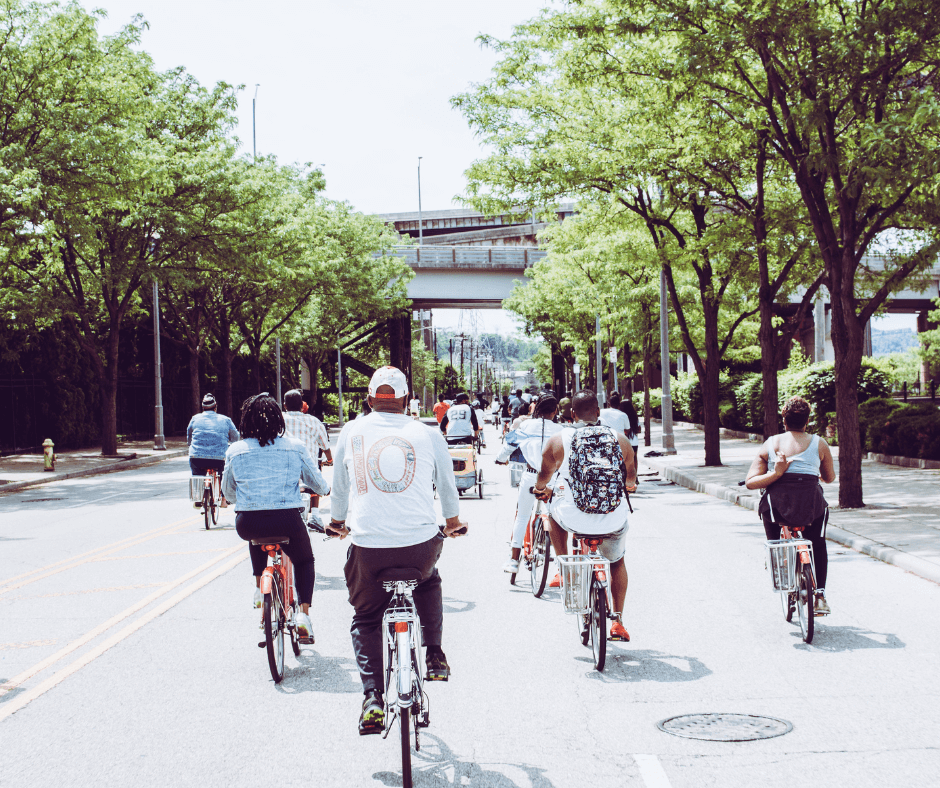
- Set Up a Group — walk, wheel, scoot, cycle or blade to work or school with others (sometimes referred to as a “bus”, e.g. a bike bus).
- Adopt a Hybrid Model — use active travel to get somewhere then public transportation to return (or vice versa).
- One Stop and Walk — if driving to visit several stores or businesses/appointments in the same area; leave your car in the first store’s car park and walk to all the others.
- Conscientious Choices — make use of or support programs and organizations that champion equity initiatives for historically underserved communities such as People for Bikes, Adapt Ability, and World Bicycle Relief.
If active travel is not currently feasible, focus on initiating changes that utilize public transportation or assisted travel using electric bikes, scooters, wheelchairs, cars and taxis, etc.
In Summary
The ways in which we adapt to an environmentally friendly and sustainable lifestyle will not be the same for everyone; however, there are many things we can commit to that will look after our planet as well as ourselves. Active travel represents just one possibility to work towards; I hope those who can make use of it get inspired to take action on an individual and local level — change begins with us.
Do you participate in active travel? What initiatives are in your local area?
Further Info:
America Walks – a leading national nonprofit that advances safe, equitable, accessible, and enjoyable places to walk and move by giving people and communities the resources to effectively advocate for change.
 transatlantic | notes
Great post Molly! Honestly, I think the biggest barrier to active travel is people’s attitudes. Our community has invested in bike lanes on main streets and all I hear is grumbling because “no one uses them and they just slow down traffic”. Change takes time and I’m happy to see our local politicians looking to the future. I sometimes wish people could get outside their echo chambers and look for the benefits in these things instead of always finding fault.
I agree 100%, it’s definitely key to have a mindset shift within a community and that is an upwards battle. I hope that people do start to see the benefit of being climate conscious, even if it does seem inconvenient to them (not having a healthy planet will end up way more bothersome).
I’m very lucky to live in an area that has a number of grocery stores and other shops that I can easily walk to. Even when I’m tempted to drive and not have to carry things, I remind myself that the hassle of driving/parking is actually more effort. Unfortunately, there are a lot of areas around me that are like you describe and are just not active travel friendly. Hopefully change will happen once more people start advocating for it.
I live in an area that is very much not active travel friendly and I wish there was more for me to walk to rather than rely on a car (I can’t drive but my husband does). The weather extremes, plus the distances, as well as the lack of reasonable public transportation makes things so difficult — but I am hopeful that will change over time!
Fantastic post, thanks so much Molly. It’s so important to keep this conversation going and I love your ideas around the simple first steps we can all take to make active travel a part of our daily lives. One further point for the list: Try setting your alarm half an hour earlier in the morning. If your mornings are always a rush, and if your commute is walkable, give yourself the time you need to make it possible, even if it’s just once a week to start with. I guarantee you’ll feel better for it 🙂
That’s a great suggestion as I think there does have to be an adjustment when changing up to walking to/from work, etc. There is a whole shift in mindset needed so this is a good tip for anyone introducing active travel into their day.
Great ideas! I like to walk everywhere. I can’t drive so I don’t have much choice – but it’s nice to know that my choices have a positive impact on the environment, too 🙂 thank you for sharing x
I agree; it’s great knowing that how we get out and about can be a useful way to help our own health and the health of the planet!
Such a great post! I never thought about active travel in these ways. I live in NYC so there are both many opportunities to participate in active travel and ways in which it’s limited. I try to walk whenever possible to the nearest location before hopping on a bus or train.
That is great you do what you can and make the most of what your area can offer in terms of active travel. I hope this becomes something that most people try out in whatever ways they can. Thanks for reading!
great read! in the US, we have a lot more bike lanes but I think people still drive more often than not. I think it will take time for people to change & consider biking as a more environmentally friendly way of travel. weather is definitely one that slows me down to the idea. but i try to walk to places when i can because it keeps me active.
I think parts of the U.S. are getting pretty good at putting in bike lanes, I wish where I lived was one of those places but they are making an effort to try and get things more climate conscious. Driving is still key for this part as distances anywhere are so great (and public transport is sadly lacking). I think things are changing though!
These are great tips, thanks for sharing.
Bernie
I’m glad they were helpful!
Interesting post! We need a mindset shift so that walking and cycling become appealing and normal. I remember most of my friends walked to school when I was young whereas more tend to come by car these days. The excuse is often that mum or dad are on their way to work anyway. So much needs to change.
I agree that a mindset shift is key otherwise even if we have all the active travel options available to us they won’t be used. I hope things improve for everyone as much as possible!
Yes fingers crossed.
I love active travel, but unfortunately infrastructure where I live (I also live in the US, like you, but in Delaware) makes it impossible to walk or bike without having to worry about angry drivers honking at me. There are parts that are getting better by them adding bike lanes protected from cars, so that gives me hope that if people want to bike or walk to the grocery store they can. Great post 🙂
Exactly; there are little to no bike lanes where I live and most walking (or scooting, etc) has to be done on the side of extremely big and busy roads (not safe). There are things being introduced to facilitate active travel so I hope I get to do it more often!
Great post! Unfortunately when I move, I’ll be in the country. So there’s nowhere I can really get to (apart from my local co op!) without driving. I’d definitely consider getting an electric car in the future though, when I’m able. We’re taking a trip to York later in the year and getting the train there, so whilst we’re there, we’ll be walking everywhere. It’ll be nice to not use the car!
This is quite similar to what a lot of people in my state and around the U.S. (for example) experience. Where I live, even though it’s a city, the distances to get to where I need to go are considerable (with poor transportation). I think an electric car could be a good step for the future. Good luck with your move!
I had an active travel last 2 months ago in Phuket. It was awesome!
That sounds amazing!
Interesting post, Molly. I do think active travel is more of a thing in urban areas, and certainly easier to retrofit in cities, as it were. Living rurally, the infrastructure isn’t there so having a car is more of a necessity. That said, our daughter does take the bus to and from school, so that’s a few car journeys saved over the course of the year!
Rural areas definitely have certain barriers and will need to rely on cars; active travel will not always be easily facilitated (I live in one of these places) but I hope future innovation can make it become more of an option for some. Thanks so much for reading!
This post is great. I love your suggestions for how active travel would work – but a mindset change is required from lots of governing bodies for it to work. I hope.this change happens.
This is exactly the issue, and why I included tips on what to support/suggest to local leaders to make these changes. Initiatives locally should be promoted and championed by communities that get elected officials to notice and act; a mindset shift is key for this.
I really like the concept of active travel, I like how travelling with this method can help with climate change and it’s such a sustainable way to travel x
Lucy
I hope more and more people find ways to implement it in some way into their own lives; healthy and sustainable is the way to go!
This sounds like a great collective. I don’t drive and get around via walking and public transport. This is doable as I live in the suburbs of NY but sadly in the bulk of the U.S. it is not so doable and the car dominates.
Allie
100% right — sadly, the car is key here in the U.S. (and will likely remain so) as so many areas are too large, rural or not constructed in a way that facilitates active travel. I hope some adaptions where possible can be made despite these difficulties with communities mobilizing to make changes.
Great post! Having travelled to Europe and appreciating their shopping daily for their meals, I’ve taken to walking to our local veg store and grocery store to pick things up several times a week instead of taking the car to buy a week’s worth at a time. I’m loving it!
When I was still in the UK, I loved being able to walk to little shops easily (the areas of Cornwall and London I grew up in facilitated this much easier than where I currently live in the U.S.). I think if it can be done, leaving the car behind and walking is such a lovely way to get healthy, enjoy the community and be climate conscious. It’s great you are doing this!
Wonderful post Molly! I especially loved your points for ways to encourage active travel. It’s definitely something to think about, especially since we can make positive changes for the environment.
I hope that more communities make these options more available and as accessible as possible. I know people are coming to see climate conscious decisions as more and more important so I hope this becomes the norm!
These are such great tips to act on if you are wanting to travel more. Thank you for sharing.
Lauren
Thanks for stopping by to read!
What practical ways to engage in a sustainable lifestyle? Thanks for reminding us that we just need to make 1 sustainable lifestyle change to start the ball a rolling.
100% agree! Just do what you can and build from there; I always find that is a great way to make something practical and lasting.
I love the idea of physically active travel but we do have lots of those barriers where I live– the nearest anything is easily a 20 minute drive by car and unless we’re in the “city” (really just the closest main town to us) there are zero sidewalks. BUT we do take advantage of physically active travel when we travel to new places. This summer my husband and I spent 4 days in Kennebunkport and walked just about everywhere we possibly could!
This sounds like much the same issues as where I live too; there is very little within walking distance and sidewalks are few and far between. I love the idea of making the most of active travel when going somewhere new — that is one of the best ways to do it!
I love doing physically active travel to travel to town and doing shopping but the yearly round sunshine sometimes makes it so difficult to upkeep.
I can imagine having that all the time would make getting about in this way a bit frustrating sometimes!