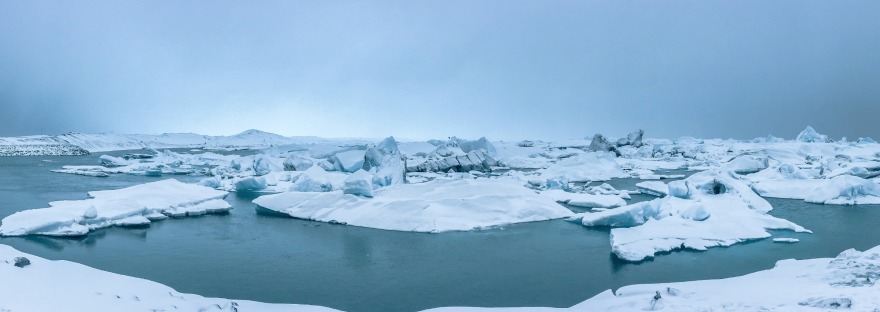
Climate change continues to pose a significant threat to the survival of a variety of wildlife in the Arctic, amplifying the need for urgent action.
The Arctic, a vast region encompassing the northernmost parts of Earth, is well known for its ice-covered landscapes and waters, extreme cold, and distinct biodiversity. Its unique ecosystems nurture diverse flora and fauna that have adapted to the harsh conditions, including polar bears, narwhals, Arctic foxes, seals, and various bird species. Sea ice serves as a crucial habitat and hunting ground for these creatures. However, rapid climate change poses a significant threat, accelerating ice melt and jeopardizing the delicate balance of life found in this area.
Despite the extreme conditions, the Arctic is one of the most biologically productive ecosystems in the world. It supports abundant fisheries and breeding grounds for countless migratory bird populations and hosts a rich array of marine life, including phytoplankton, fish, and marine mammals. The life cycle in this region is integral to global biodiversity and serves as a crucial indicator of environmental health. Changes in the hunting, scavenging, and migration behaviours and patterns of Arctic animals often reflect shifts in climate and habitat conditions, providing crucial insights for monitoring and mitigating the impacts of global warming.

This post is part of the Climate Change Collective, a group of environmentally-minded bloggers who share valuable climate action news. Started by Michelle from Boomer Eco Crusader and Jamie from Jamie Ad Stories, each month a different member contributes a lead/focus post that the rest of the collective responds to on their own sites, further discussing the information and issues raised.
The collective is currently open to any other bloggers who want to join; if you are interested, get in touch.
Collective Climate Action
The most recent lead/focus post for the collective was written by Michelle from Boomer Eco Crusader, where she shares some valuable information about how climate change in the Arctic affects us all. To many, it may seem like a distant, out-of-reach place that does not have much bearing on our lives, but we could not be more wrong. Those who live in or near the Arctic region see how climate change is impacting them (which includes parts of Canada, Alaska (U.S.), Russia, Greenland (Denmark), Norway, Sweden, Finland, and Iceland), and it’s important all of us heed the warning signs.
The frozen, white surface that used to exist year-round across much of the Arctic helped to keep the Earth cool by reflecting most of the sun’s energy back into space. […] The loss of ice cover has been a key factor in the Arctic warming four times faster than the rest of the planet since 1979. | How Climate Change in the Arctic Affects Us All – Boomer Eco Crusader
Michelle highlights that the main issue is that as the planet continues to warm, sea ice in the Arctic region is melting at an unsustainable rate. Scientists and researchers believe that we have crossed a threshold, one where it’s too late to save Arctic ice during its summer months (June–August), and the prediction that it will become ice-free during the summer season by 2030 is now all but inevitable. The people and wildlife that depend on the ice for habitation, travel, scavenging, and hunting are now being left with fewer options—a direct threat to their existence and, by extension, ours.
As mentioned in her informative post, Michelle also touches on the plight of polar bears and walruses as they increasingly struggle to find food, enough ice cover, and land to live on safely. This piqued my interest, and I decided to look into what other animals are facing an uncertain future because of climate change in the Arctic.
9 Animals in the Arctic Impacted by Climate Change
Arctic animals play an integral role in ecosystem dynamics and global biodiversity. Climate change that causes global warming poses a severe threat, disrupting their habitats, food sources, and migration patterns. It’s therefore crucial that we stay informed and know what steps we can take to help conservation efforts that aim to preserve and maintain ecological balance in this fragile environment.
Narwhal (Monodon Monoceros)
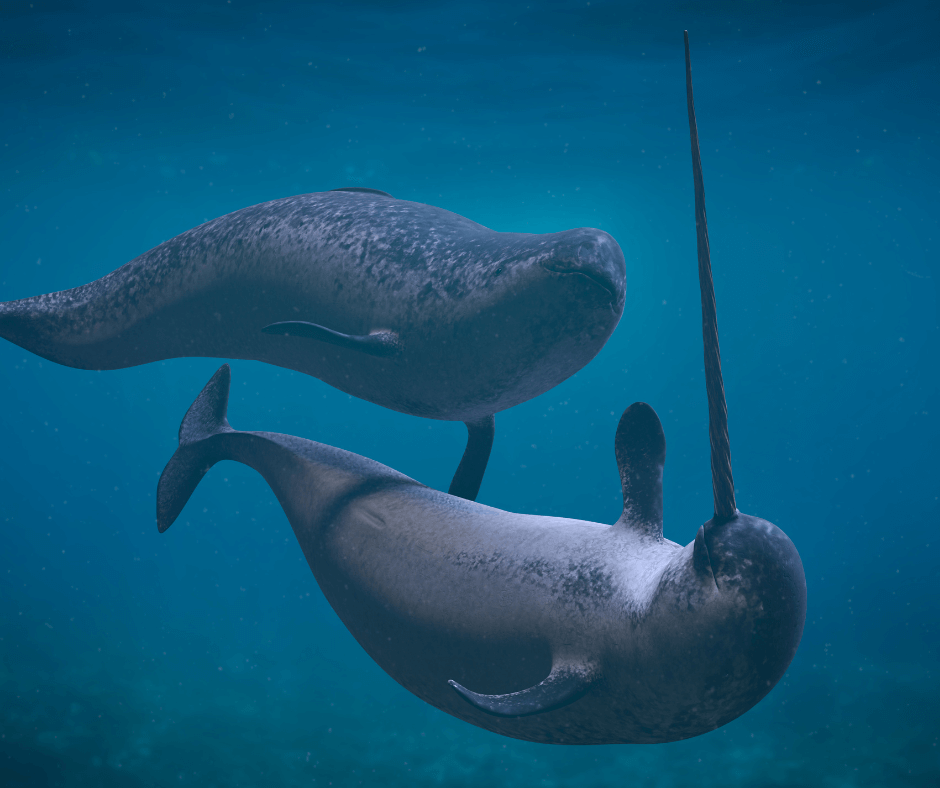
Conservation Status (via IUCN Red List): Least Concern
How to Help: The Arctic Species Conservation Fund | Adopt a Narwhal
Narwhals are a species of toothed whale, sometimes referred to as “unicorns of the sea” because of the distinctive, single tusk that the males grow (females have been known to have smaller versions, but it’s quite rare). Despite them not (yet) being considered a threatened or endangered marine mammal, they are quite vulnerable to the changes global warming brings because they rely on sea ice for breeding, feeding, and shelter. Melting ice disrupts their habitat, alters food availability, and increases their exposure to predators, threatening their survival. Narwhals have been known to delay their seasonal migration, which potentially points to some type of adaptability, but if their breeding bays and fjords continue to shrink or disappear and their food sources are further limited, that point becomes moot.
Additionally, narwhals (and many other Arctic animals) use echolocation for communication and navigation. This vital behaviour is becoming more frequently disrupted because of increased human activity from shipping for tourism, fishing, and resource exploration. Narwhals, in particular, seem to be most sensitive to this, becoming very stressed by underwater noise.
Saimaa Ringed Seal (Pusa Hispida Saimensis)
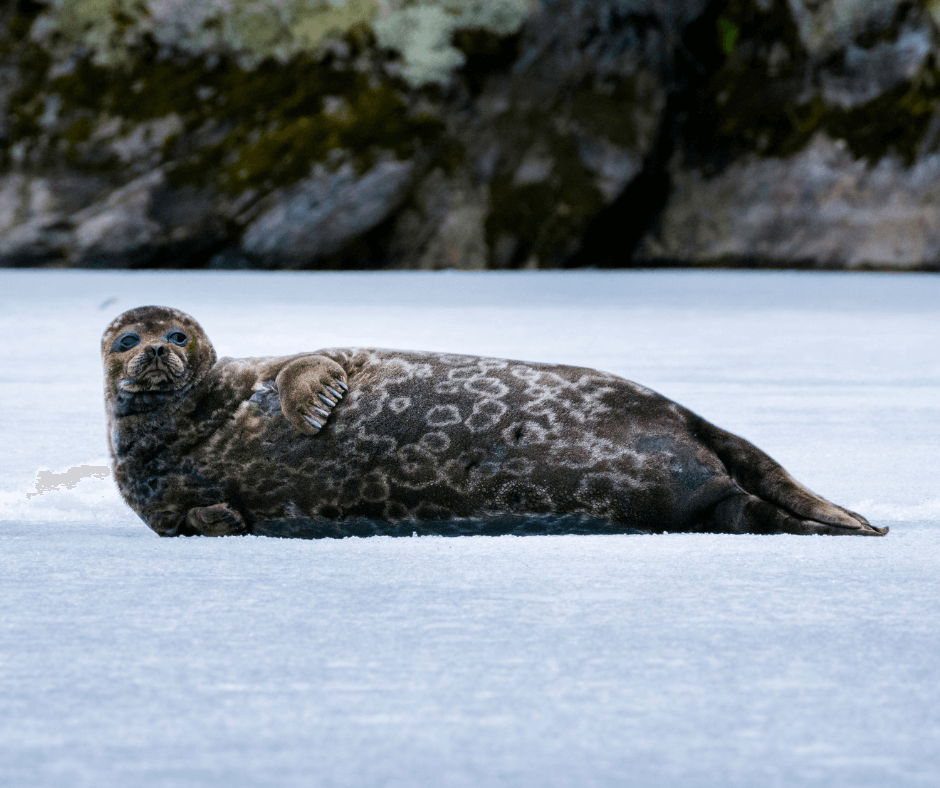
Conservation Status (via IUCN Red List): Endangered
How to Help: The Finnish Association for Nature Conservation | Metsähallitus Parks & Wildlife Finland
One of the most rare and endangered seals is the Saimaa ringed seal, a marine mammal whose numbers have dwindled to about 480 and are only found in Lake Saimaa, Finland. Their numbers initially dwindled because of hunting, but they have grown slightly since the 1980s, when conservation efforts were put in place to save them. Now climate change is further threatening their already severely limited population. Melting or disappearing ice and snow cover, which the seals use for nesting and building lairs to shield their pups from the cold, predators, and human intrusion, is disappearing.
Walrus (Odobenus Rosmarus)

Conservation Status (via IUCN Red List): Vulnerable
How to Help: Alaska Sealife Center | Defenders of Wildlife
Known for their massive size and iconic tusks (on both males and females), walruses inhabit the icy waters of the Arctic. These sociable marine mammals rely heavily on sea ice for breeding, nursing, and resting between dives for food. However, climate change is drastically altering their habitat. Rapidly melting ice forces walruses to travel farther distances to find suitable resting spots, leading to overcrowding on remaining ice floes. As a result, incidents of stampedes and fatalities have increased. Additionally, warmer temperatures affect the availability of their main food source, clams and other benthic invertebrates. These combined impacts threaten the survival of walrus populations in the Arctic.
Polar Bear (Ursus Maritimus)
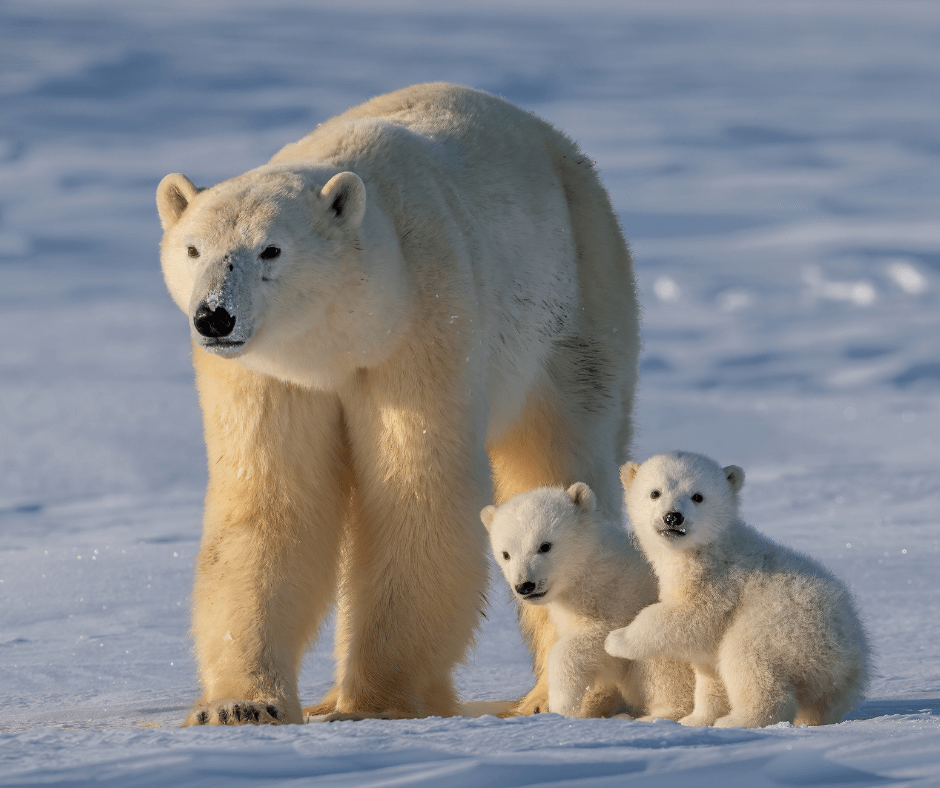
Conservation Status (via IUCN Red List): Vulnerable
How to Help: Polar Bears International | Adopt a Polar Bear
Polar bears, native to the Arctic region and surrounding areas, are a uniquely adapted, large-apex predator perfectly suited to the icy environment they inhabit. With temperatures known to plunge to -40° or -46° C (-50° F) in winter, polar bears remain warm because of a thick covering of body fat and two layers of fur. Their dinner plate-sized paws are covered in papillae—small, rounded, soft bumps—that grip the ice, preventing slips and falls.
These majestic bears rely on sea ice as platforms for hunting seals, their primary food source, yet climate change-induced warming has led to a significant loss of sea ice, reducing hunting grounds and forcing polar bears to travel longer distances in search of prey. Extended ice-free seasons also mean less time for successful hunting, leading to malnutrition and decreased reproductive success. With diminishing ice, encounters with humans and scavenging for alternative food sources pose additional threats. These compounding effects pose serious challenges to the survival of polar bear populations.
Arctic Fox (Vulpes Lagopus)

Conservation Status (via IUCN Red List): Least Concern
How to Help: Arctic Fox Centre (Melrakkasetur Íslands) | Center for Biological Diversity
Arctic foxes are known for their thick fur—which insulates against the cold and maintains their body temperature at 40°C (104°F)—and for being well adapted to dealing with harsh Arctic conditions. Their tails are used as a toasty blanket when they sleep, and their paws are completely covered in fur so as to muffle their movements as they search for prey.
These small mammals hunt for lemmings and other rodents and forage for berries and carrion, which is being made more difficult by the formidable challenges climate change poses as it noticeably alters their habitat. Declining snow cover disrupts their camouflage during hunts, making them more vulnerable to predators. Moreover, thawing permafrost affects their dens, which are crucial for shelter and raising young. Changes in prey availability and competition with larger predators also further threaten their survival.
Less ice means less reflected heat, meaning more intense heatwaves worldwide. But it also means more extreme winters: as the polar jet stream—a high-pressure wind that circles the Arctic region—is destabilized by warmer air, it can dip south, bringing bitter cold with it. | Six Ways Loss of Arctic Ice Impacts Everyone – WWF
Muskox (Ovibos Moschatus)

Conservation Status (via IUCN Red List): Least Concern
How to Help: Alaska Wildlife Conservation Center | Protect the Arctic
Belonging to the hoofed mammal family Bovidae (the same as goats, cows, sheep, bison, and wildebeest), the muskox is an herbivorous animal native to the Arctic region. Known for their thick coats, impressive horns, and musky odour produced by the males when mating to attract females, these resilient creatures survive off a diet of grasses, mosses, and lichens.
Despite living in an area well-known for seasons and cycles of extreme cold weather, muskox are not particularly adapted to digging or foraging in heavy snow or thick ice. During the winter months, they become restricted to finding food and grazing in areas with shallower snow coverage—which climate change is making harder to do. Warming temperatures lead to increased rain and ice formation, encasing their forage in impenetrable layers. This reduces food accessibility and quality, impacting muskoxen’s ability to thrive. Additionally, thawing permafrost destabilises their habitat and exposes them to new predators, making their long-term survival more perilous.
Reindeer/Caribou (Rangifer Tarandus)

Conservation Status (via IUCN Red List): Vulnerable
How to Help: Caribou Conservation Alliance | Sierra Club
Perhaps one of the most iconic animals found in the Arctic, caribou are a species of large herbivorous deer that have adapted well to the cold environments they migrate to. Some of the fascinating ways caribou survive the freezing climate include the fact that they have two layers of fur, with the fur itself being completely hollow, thus trapping heat. Additionally, their wide spread, large, and concave hooves keep them steady while walking on snow and ice and can act as effective paddles when swimming across lakes and rivers.
These beautiful creatures play a vital role in the Arctic ecosystem, serving as prey for predators like wolves and bears and subsistence for human populations. Their grazing and trampling of various plant species as they feed and move about can also suppress or promote the growth of forageable plants. Trampling behaviour, for example, impacts soil nutrient cycling and plant regeneration processes. By selectively feeding on specific plants and altering vegetation dynamics, caribou indirectly influence the habitat suitability for other wildlife species and contribute to the overall functioning of Arctic ecosystems.
However, this delicate balance is being disrupted by climate change as warmer temperatures lead to habitat fragmentation, affecting migration routes and forage availability. The increased frequency of extreme weather events also exacerbates stress and reduces reproductive success, while changing snow conditions impact the concealment of calves from predators.
Red Knot (Calidris Canutus)
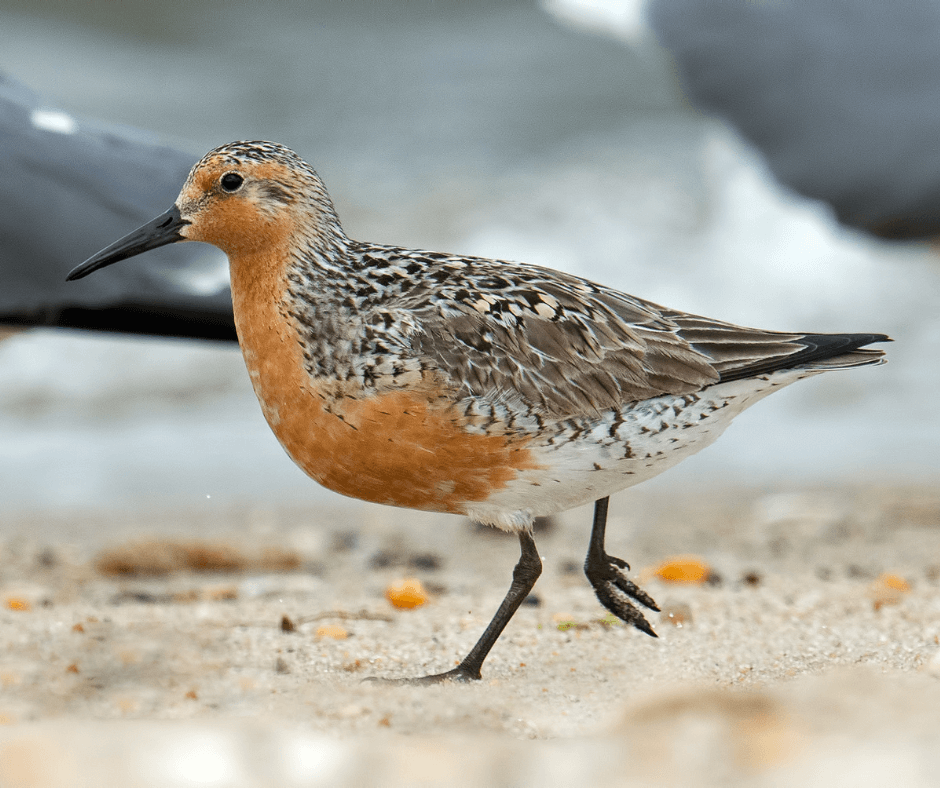
Conservation Status (via IUCN Red List): Near Threatened
How to Help: American Bird Conservancy | Audubon Alaska
Red knots are migratory shorebirds known for their long-distance journeys between their Arctic breeding grounds and wintering areas in the southern hemisphere. These birds depend on Arctic ecosystems for breeding and foraging during the summer months, but climate change is altering their habitats and food availability.
Warmer temperatures affect the timing of insect hatches, crucial for chick survival, and disrupt the synchronisation of migration with food availability. Additionally, melting sea ice affects the distribution of prey species along their migration routes. These climate-induced changes pose significant challenges to the survival and reproductive success of red knot populations in the Arctic.
Spoon-Billed Sandpiper (Calidris Pygmaea)

Conservation Status (via IUCN Red List): Critically Endangered
How to Help: Arctic Audubon Society | Spoon-Billed Sandpiper Task Force
Spoon-billed sandpipers are charismatic, monogamous shorebirds renowned for their unique spoon-shaped bills and remarkable migratory feats across vast distances. These birds breed in the Arctic tundra, where they rely on shallow coastal habitats for nesting and foraging—all of which are being unsettled by a range of issues that are being made significantly worse by climate change.
Rising temperatures alter the timing of insect emergence, which is critical for chick survival, and can lead to mismatches with breeding seasons. Moreover, sea level rise and coastal erosion threaten their nesting sites. Diminished prey availability due to changing habitat conditions further compounds their chances of survival.
In Summary
Hopefully, this article highlighted some of the profound impacts climate change has on Arctic wildlife and the dire consequences it unleashes on an ecologically diverse region. It’s clear that melting sea ice, thawing permafrost, and shifting habitat conditions are key disruptors in the Arctic, leading to food shortages, habitat loss, and increased vulnerability to predators and disease.
There’s an urgent need for conservation efforts to mitigate these threats and well-informed advocacy for collaborative initiatives that aim to reduce the threat that global warming brings. By raising awareness and taking action at an individual, collective, political, and industrial level, safeguarding Arctic wildlife and their habitats for future generations is possible.
How are you helping to save the Arctic? What animals are you passionate about helping?
Further Info:
The IUCN Red List of Threatened Species
How Climate Change is Changing Animal Habits – NEEF
Alaska Communities Must Adapt as Climate Change Transforms State, Federal Report Says – Alaska Public Media
 transatlantic | notes
It’s so sad that these animals who live in the Arctic are being negatively impacted by climate change. It’s important that we act now to help these animals there x
Lucy
And so many more are impacted, hopefully this raises a bit of awareness that inspires action. We cannot let these Arctic animals encounter more threats or decline. Thanks for reading!
This is powerful, sobering and so important…I will share this soon and bravo to you for such an important post
Researching and compiling this post really did open my eyes even more to the struggles the Arctic (and the planet) faces. Thanks so much for taking the time to read and share it!
It is honestly horrifying that we have not been able to stop this further!
It really is, especially as this is not new information. Climate decline like this has been known about for decades, and yet those in power are still slow to act.
You write in depth about the tragic vulnerability of creatures in the Arctic region. It worries me that people are not more concerned generally about these areas, mainly because humans don’t tend to live there I suspect.
The Arctic is the barometer for climate change and is sending urgent signals which we must act upon.
Thank you for outlining this brilliantly.
I also feel that for many people it is a case of “out of sight, out of mind”, even though the alarm bells have been ringing about this issue for a long time. I hope that more and more people take the time to learn just how important the Arctic is, and how it is how we can measure the health (and future) of the planet. Raising awareness is necessary, as is taking action to slow climate change.
Thanks for this, Molly. It’s frightening how many of our beloved arctic creatures are at risk.
It was both fascinating and disheartening to learn about these animals as I did my research for this post.
We need to act now before it is too late! It break my heart to see how these innocent animals are affected by self-fish actions of us humans.
I agree 100% and I hope that more can and will be done. It’s an urgent issue we cannot ignore.
it’s sobering seeing that our actions are affecting these animals. We need to act now!
Very sobering indeed, it’s incredible just how much climate change is impacting many areas and animals right now. Thanks for reading!
Thank you for this. This is so important, the more people who know and understand, the more we can make efforts to help mitigate the negative effects.
I hope that this is educational and informative so that more people can find ways to help. The animals and the land/ice in the Arctic is essential, and we need to protect it.
Thank you for highlighting such an important issue, Molly. It’s so disheartening to learn what’s happening to these animals. I will be checking out the resources you’ve shared to see how I can help!
Thank you so much for looking into the resources here and ways you can support these animals in the Arctic. Hopefully, this raises awareness for many more people and action can be taken.
This is well written Molly. I wish more folks would get involved and educate themselves on climate change. These animals need their habitat to change as little as possible to survive. It makes me so sad.
Everything is definitely on a fine balance, which as we clearly now know is faltering. The very real consequences of not taking action now are striking. Hopefully, as you point out, more people will educate themselves and take action.
I’m so glad you’re bringing this to everyone’s attention. It’s something that concerns me greatly. However, it sounds obvious now that I’ve read it here, but the loss of year round ice cover in the arctic is making the earth warmer. very scary!
I just hope that we, as a human race, can turn the tables on climate change before it’s too late.
Lindsay The Travel Vine
I hope all of us, but particularly those in power take this seriously and find ways to ensure the protection of the Arctic. It’s vital that we don’t drag our feet and allow this situation to reach too many “no return” thresholds. Thank you so much for reading!
This is such an important topic. Thanks for bringing it to light.
Thank you so much for stopping by to read it!
The predictions of what’s going to happened in the future is really scary because of climate changed. I heard there are a lot of artic animals became endangered species now.
Yes, it is really scary seeing climate change wreak havoc in the Arctic (and beyond). So many species are now threatened or endangered, and it’s truly a worrying time.
The Arctic has some really cool and amazing wildlife! I love that you’ve highlighted a number of different animals that we don’t often hear about. The Arctic sounds like a cold and barren place, but the more I’m learning about it, that’s not really the case. The melting ice is going to have such a devastating impact on so many creatures.
I had not idea that there were so many different animals that either lived in or migrated to the Arctic, and just home thriving it is. The melting ice has so many far reaching impacts that it was great to learn more about it as I researched this. Everything is connected, and climate change is disrupting that balance. Thanks for reading!
I struggle not to cry when reading things like this. Thank you for this post. I’ve bookmarked it so I can come back later and check out some of the websites under your “how to help” heading and hopefully donate to a few.
It can be really sad reading things like this or becoming aware of particular animals and their struggles. Making donations to places that work hard to protect the Arctic is a great way to help. Thanks for reading!
It’s sad that there are so many Artic animals being affected by climate change. Thank you for highlighting 9 of these animals and how we can help. I’ll have to look into the organizations you linked.
It is really alarming to learn how these animals (and many more like them) are being negatively impacted by climate change. Thanks for looking into how you can help!
A brilliantly informative article which zooms in on vulnerable animals in the Arctic region.
This issue is important and impactful.
There are some many impacts currently happening that it’s vital we all become aware of what is going on, and how we can help. Thanks so much for reading!