
Our voices can hold purpose and power, even when we do not feel loud enough, strong enough, or sure of ourselves—but still, speaking up matters.
Raising our voice to defend ourselves and others can be incredibly difficult. The fear of conflict, rejection, or not being heard often holds us back. Yet using our voice—whether advocating for ourselves or others—remains a meaningful step to take. It may require courage, practice, and persistence, but even small acts of assertive communication can create positive change on an individual, social, or political level. Every step towards finding our voice brings us closer to using it with intention and resolve.
It is natural to feel uncertain or afraid—what counts is that we try.
Speaking out to stand up for something is essentially a call to action. In our everyday lives, this could include setting personal boundaries that assert our needs, challenge harmful behaviours towards us, or expressing our values and beliefs with confidence, even in difficult conversations.

It is also about fighting against larger systemic issues that target or disproportionately impact historically marginalised and underrepresented communities, or when politics is used to undermine rights, restrict freedoms, or reinforce inequalities and discrimination.
All this is to say that whatever moves us to protect our peace, raise awareness, or stand for meaningful change, speaking out is how we contribute to progressive transformation.
Sometimes, it is said that silence can be an effective communication tool—choosing what you respond to or give energy to. There is no doubt that, when used at the right time, it allows the still hush of tranquillity to send a clear message. It should be used in this way, particularly if it is healing and empowering.
However, silence—when it fails to stand up against harm, division, chaos, corruption, or other personal and social ills—will eat away at our conscience, integrity, and collective humanity. Allowing harmful things to persist and go unchallenged can be a costly gamble.
This is not to say that speaking up is easy. As mentioned before, it can bring fear and the possibility of backlash, rejection, or even personal loss. We certainly cannot support or defend every issue that may benefit from amplification, but when we feel that unease in our gut and the pull of conviction in our heart, we know that this is the moment to take a stand.
Learning how to productively stand up for ourselves in daily life or push back against social injustices is a process that takes time and practice. We may not feel confident at first, but by starting small and building from there, we can develop courage and determination.
Knowing when and how to use our voice—whether advocating for ourselves, supporting others, or resisting injustice—begins with understanding the message we want to convey. Small, consistent efforts can have an impact, and the more we practise, the stronger our voice becomes.
Using facts, personal experiences, or storytelling can strengthen our assertions. Additionally, choosing the right time and medium—such as conversations, social media, or public forums—can increase the likelihood of being heard.
Speaking up also involves actively listening to and supporting others who face personal or systemic barriers while holding space for meaningful discussions. It also requires a willingness to learn from inevitable mistakes and to accept correction or accountability when we misstep, overlook important perspectives, or inadvertently contribute to the very issues we seek to challenge.
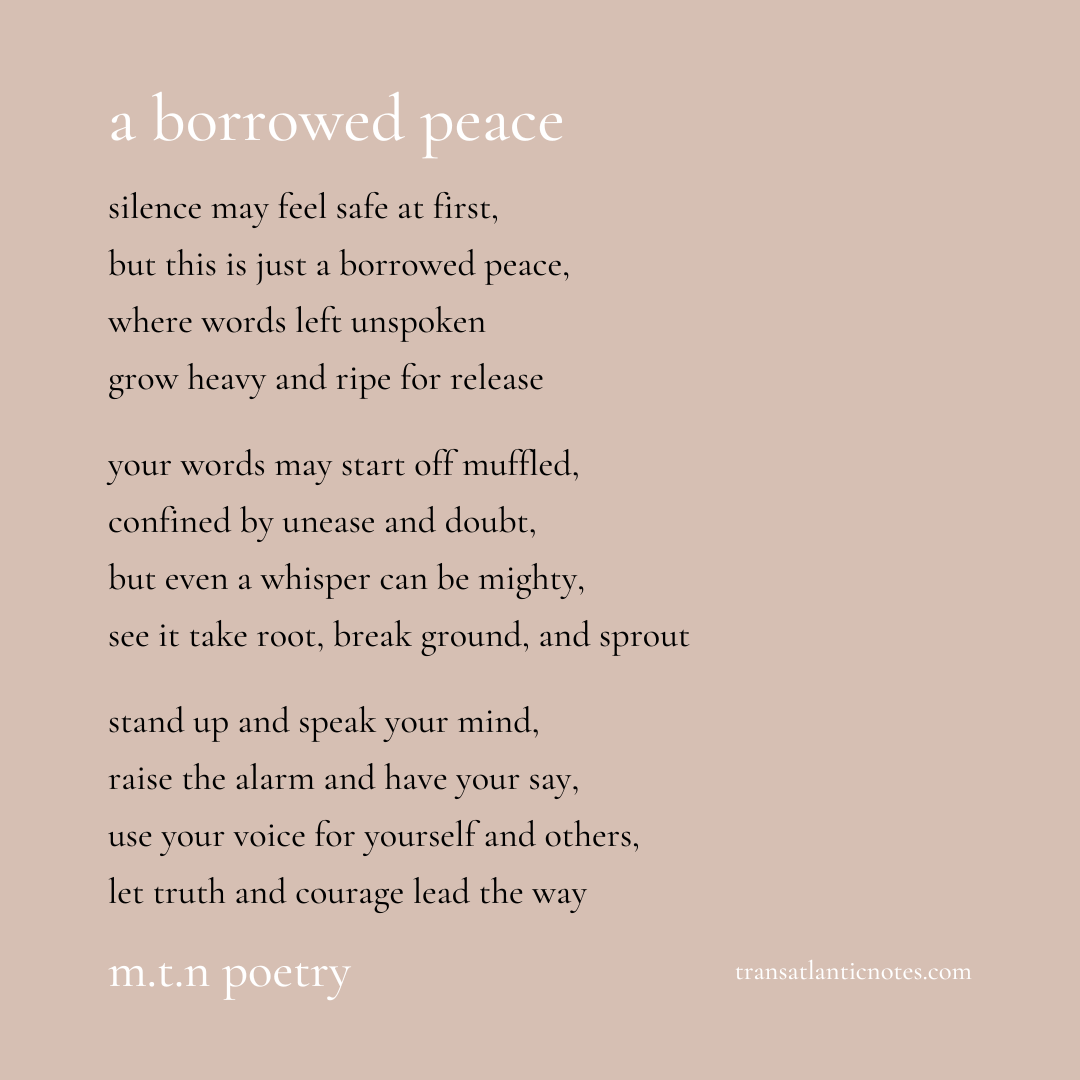
This can all make speaking out sound as though it is fraught with uncertainty, discomfort, and risk. However, it is also a powerful act of courage, growth, and necessary change. The poem I wrote and shared here is a reminder and testament to the fact that, despite all this, our voices have value. Even when speaking up feels difficult, it can spark awareness, inspire others, and create ripple effects far beyond what we can see.
Many of us often have doubts about expressing ourselves, but the act of speaking out is never in vain. It can open doors to new conversations, improve personal relationships and interactions, challenge norms, and ultimately contribute to a collective responsibility—even if it takes time to fully unfold.
No matter what our reasons are for wanting to raise a defiant voice, it is essential that we remember our words have purpose and strength. Speaking up in any capacity where it is needed can affirm our own dignity and that of others.
Fear and uncertainty may try to restrain us, but staying silent may eventually become untenable. At this point, no matter whether it is to enforce personal boundaries to protect our well-being and values, or getting into what is often called “good trouble” when taking a stand to challenge harmful societal or political systems, speaking out becomes an act of both self-preservation and social consciousness.
Each act of resistance strengthens our confidence and contributes to a culture of courage.
What have you spoken up about recently? How do you use your voice to help yourself and others?
Further Info:
25 International Human Rights Organizations – Human Rights Careers
Learn How To Stand Up for Yourself and Take Control of Your Life – BetterUp
This is part of my M.T.N. Poetry Collection. To share it on Instagram, Pinterest, or X (Twitter), please tag my corresponding social media accounts. Do not edit my work or remove/crop out my name or site address from being clearly visible within the post. For all other purposes, please contact me for permission so that information regarding terms of usage can be provided. Thank you.
 transatlantic | notes
Agree! Be like Atticus Finch in To Kill A Mockingbird. Have courage to stand up for justice. One day, you might be the one that makes a difference.
Yes, a great character to point to! I think we all need to remember that we can make positive changes.
Such a timely post for me Molly. These truly are difficult times in our world and you’ve made some great points. I loved your poem.
This was what I’ve been thinking about since things have turned politically around the world. I’m glad this turned up at the right time!
Great post and so true! Though speaking up can be difficult, silence as an alternative often represents a privilege of indifference, especially regarding the safety and wellbeing of others. Thank you for sharing!
It can be tough to know how to effectively use our voice, but in the defense of others— particularly targeted groups—it so necessary. Thank you for sharing your thoughts on this!
Words are always powerful, that’s why it’s important we choose them wisely. Great post. I have always stood up for myself and injustice, I think we have a responsibility to take stand against injustice and wrongdoing. As Martin luther King Jr., said, “Injustice anywhere is a threat to justice everywhere.”
The words of Martin Luther King Jr. are powerful and resonant today, and the work he was apart of certainly continues. Standing up for ourselves, other people, and against injustices is a great way to take a meaningful stand. Thanks for reading!
I don’t think this article could be better timed, with everything going on in the world at the moment. Reading your words reminded me of the poem, First They Came by Pastor Martin Niemöller. Silence can’t always be the default option.
I have felt the pull to write a poem an a post like this given all that has gone on in the world, and especially with politics being what is it right now here in the U.S. Pastor Niemöller’s poem is exactly what not speaking up can lead to. A valuable reminder to take a stand.
A great post and a really lovely written poem! x
Thank you so much for enjoying it!
It can hard and scary to speak up. But I feel like we need this more then ever in this day and age. Because we are living in some scary times for sure. But the poem is lovely.
It can be really hard to take a stand and speak out, but it all makes a difference. I hope more and more people find their voice, and start to use it. Thank you so much for reading!
Excellent post.. now is exactly the time when we should be speaking out rather than remaining silent.
I ma so pleased that this resonated in this way, it is indeed the time to speak up, and speak out.
Your poem is fantastic and well-written, and even though it can be difficult to speak up, it is important to speak out against wrongdoing.
There is always an element of fear, discomfort or uncertainty when speaking out, but if we can do it in some way, it can really make a difference. Thanks so much for reading!
First of all, can I just praise your beautiful writing? It’s so descriptive and emotive. Secondly, you’ve captured how so many feel right now. It’s not easy to speak up, nor comfortable at times but it’s something we must do, especially when we’re privileged enough to do so.
Thank you so much, this comment made my day! I always try to write things that resonate and connect with those reading. I hope this inspires action and awareness!